

Alberta vs Ontario: How Player Protection Compares
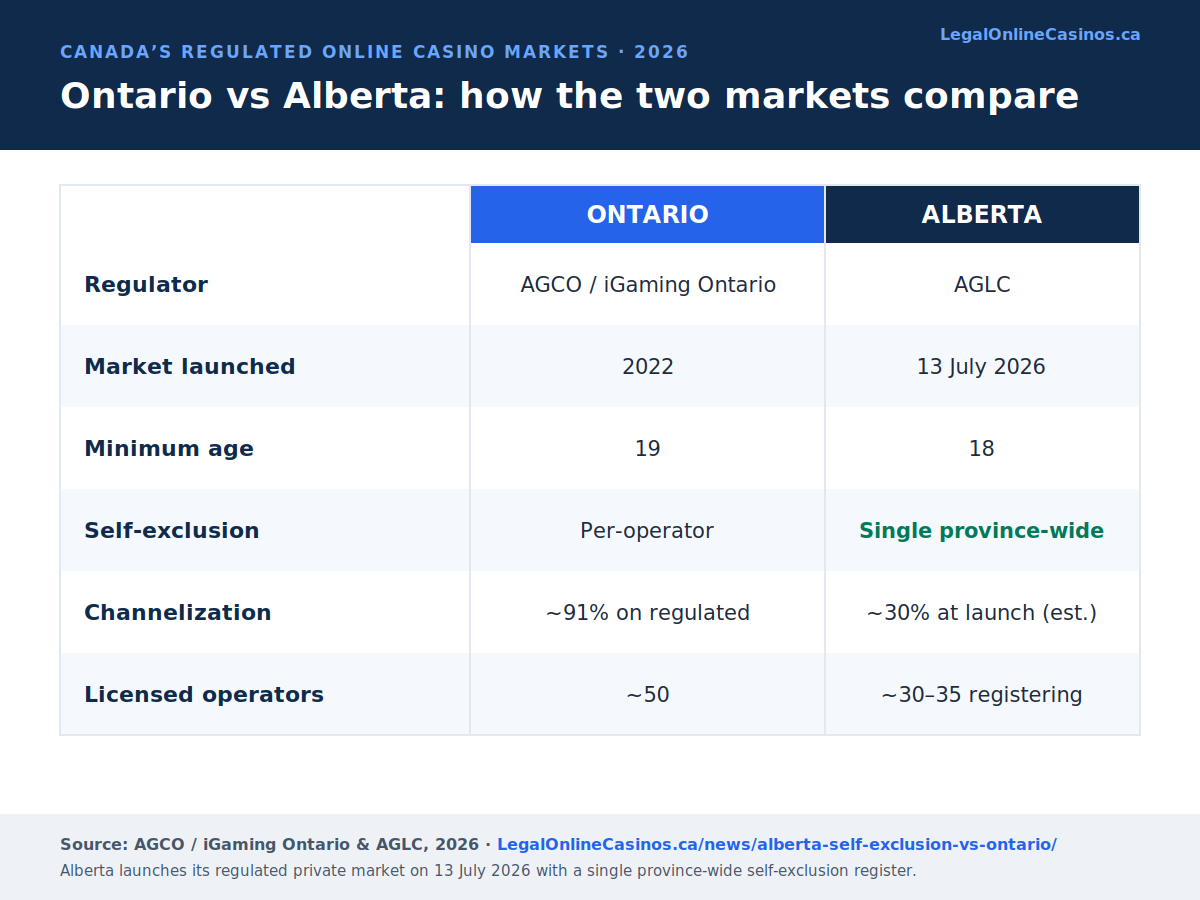
Both Ontario and Alberta run regulated online casino markets, but they do not protect players the same way. Alberta launches on 13 July 2026 with one safeguard Ontario still does not have years into its market: a single, province-wide self-exclusion switch. The two markets protect players differently, and it is worth knowing where each one is ahead.
What Alberta's centralized self-exclusion does
Self-exclusion lets a player ban themselves from gambling for a set period. According to the AGLC, Alberta's version is centralized and mandatory across every registered operator: exclude once, and it applies to all licensed Alberta casinos at the same time, ideally across online and retail channels. You do not have to chase down each casino individually for the block to take effect.
Why this is ahead of Ontario
Ontario's regulated market, live since 2022, still relies largely on per-operator self-exclusion: excluding at one casino does not automatically exclude you at the next. A player trying to stop has to repeat the process operator by operator, the gap a centralized system is designed to close. Alberta launching with the centralized model from day one is a genuine, if quiet, improvement on Ontario's playbook.
A single switch that covers every licensed operator is the most useful player-protection feature in Canadian iGaming, and Ontario still lacks it.
The honest caveat: tooling isn't safety
A better system is not a solved problem. Self-exclusion only works if a player reaches for it, and researchers consistently note that determined players can still find unregulated offshore sites outside any provincial register. Centralized exclusion raises the floor; it does not remove the need for deposit limits, time limits and, when it matters, real human support.
How to actually use the protections
- Set limits before you play. Deposit and time limits are most effective set at signup, not after a bad session.
- Use self-exclusion early. In Alberta it covers all registered operators at once; in Ontario, apply at each operator you use.
- Only play at registered operators. Protections only exist inside the regulated market, an offshore site is outside the self-exclusion register entirely. Check our legality guide.
- Get help when you need it. Free, confidential support is available. See our responsible gambling resources.
What this means for the rest of Canada
As more provinces move toward regulated private markets, Alberta's day-one centralized model sets a higher bar than Ontario's. For players it reinforces the core message of a regulated market: the protections that matter, fund segregation, dispute paths, self-exclusion, only apply when you play at a licensed operator. We cover the full launch in what Alberta's July 13 launch changes.
Frequently asked
Does Alberta's self-exclusion cover every casino?
Alberta's model is centralized across all AGLC-registered operators, so a single self-exclusion applies to every licensed Alberta casino at once, unlike Ontario, where you generally exclude operator by operator. It does not cover unregulated offshore sites.
Why doesn't Ontario have a single self-exclusion switch?
Ontario's regulated market launched in 2022 with largely per-operator self-exclusion. A unified, cross-operator system has been discussed but is not yet in place, which is why Alberta launching with one is notable.
Where can I get help with gambling in Canada?
Free, confidential help is available across Canada via aide-jeu (aidejeu.ca) and, in Ontario, ConnexOntario. All licensed operators must also offer self-exclusion, deposit limits and time-out tools.